The Achilles Project · A novel about putting AI to work, by Jeremy Evans
Press kit
Watch one company learn, the expensive way, what it takes to run AI in production, so yours doesn’t have to.
Join the book waitlistDownload the front cover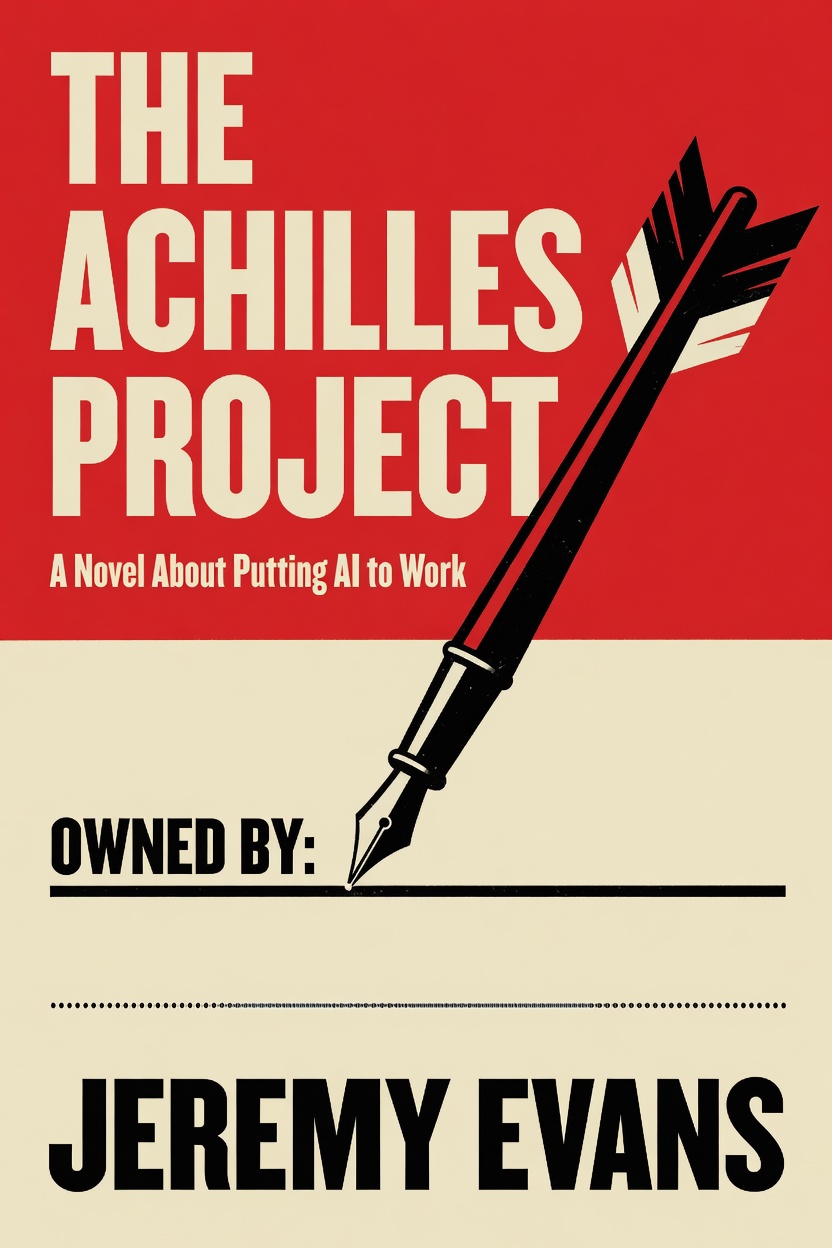

Press kit
Start with the story.
From the novel. Lares Specialty Insurance and everyone in it are fiction, and so are the figures.
The short pitch
An operations VP has 120 days to make AI work before examiners arrive. The tools are the easy part. The Goal, for AI in production.
The back-cover pitch
A four-billion-dollar insurer, and nobody can say how it decides anything. Don Calder, an outsider VP of Operations, bets the company on AI with 120 days until the examiners arrive. His first model works in a weekend. Then it grades a fatality as moderate. The vendor bills for its own exit interview. One month’s AI bill reads $247,311.08, and a $55 million hole is hiding under a filter nobody reads.
The Achilles Project is the novel about the part after the strategy deck: a name on every answer, checks the prose can’t talk past, and a meter on every call.
The full story
Somebody slid a page across the table. It said to put AI to work, fast and safe, and to have a defensible number by a date.
Don Calder gets that page on his first morning at Lares Specialty Insurance, a four-billion-dollar trucking insurer that runs on memory, handshakes and a mainframe nobody alive built. The state examiners arrive in 120 days, and a fifty-five-million-dollar hole is hiding under a filter nobody reads.
He does what capable operators do. He builds a working model in a weekend, and it grades a fatality as moderate. He hires the vendor with the logos, and gets a magic show and an invoice for its own exit interview. He bans the unapproved tools, and his senior people move to the parking lot while the dashboard shows 120 of 120 seats logged in. He runs forty AI projects, and every one is ninety percent done. One month’s AI bill reads $247,311.08, and nobody can say which work caused which dollar.
None of it is a technology failure. Each one is a failure of ownership, of checking or of measurement. The people who saw it coming are the ones he tried to route around: a claims veteran who won’t sign what she hasn’t read, a young adjuster running AI on a personal account, the one woman who can still find anything in the old system.
The Achilles Project is a novel about the part after the strategy deck. One operation climbs nine stages of AI adoption, in order, and walks into its examination with a record that shows its error rate and who signs for it. The whole operating system is in the back of the book: ten pieces, fourteen rules, three questions.
You will recognize your own building. Then you will know what to fix first.
Why a novel?
The failures that sink AI in production don’t look like failures when they happen. They look like a green dashboard, a fluent rationale, a great demo, a sensible ban. A playbook can state the rule; a story makes you sit through the week the rule didn’t exist, and watch someone pay for it. That’s the form The Goal used for the factory floor and The Phoenix Project used for IT. There’s a practical reason too: a whole team can read one book and argue about the same scene on Monday morning, which a framework deck rarely survives. And for the reader who wants the rules without the story, the book puts them in the back, bare.
Press kit
Questions worth asking.
- What changes when an AI answer has a named human owner?
- How do you check fluent output before it becomes a consequential decision?
- What does a cost meter tell an operator that a monthly AI bill cannot?
- What can leaders learn from the tools their teams use around the official policy?
- How do you turn a collection of nearly finished pilots into one completed piece of work?
- What should an operation be able to take with it when it leaves an AI vendor?
- How can a team use a scene from the novel to discuss its own work?
- Why tell the story of AI in production as a novel?